
When Should You Send Wedding Invitations? (2026)
Choose the wedding invitation mailing date, weigh one complete suite, confirm postage and ask about hand-canceling before sending.
Last updated October 2026
Contents9
- When should you send wedding invitations for a standard wedding
- When do wedding invitations go out for destination plans
- When do you mail out wedding invitations near a holiday
- Finish the suite before you buy postage
- Weigh one finished suite at the post office
- Ask about hand-canceling
- A mailing-day checklist
- Follow up after mailing
- Verdict on sending wedding invitations
Send wedding invitations 6–8 weeks before a standard wedding, or about 3 months before a destination wedding. Choose the mailing day early enough to leave time for replies and follow-up before the venue needs a final count. Weigh one complete suite before buying stamps, and check the heaviest version if some guests receive extra inserts.
The short answer: standard wedding invitations go out 6–8 weeks ahead; destination invitations go out about 3 months ahead. Lean toward the earlier end when replies travel by mail or guests need extra planning time. Assemble one complete sample, confirm postage at the post office, ask about hand-canceling if desired, and record each household's send date so returned or missing mail is easy to track.
When should you send wedding invitations for a standard wedding
Emily Post's wedding planning timeline places standard invitations 6–8 weeks before the wedding. The Knot's timing guide gives the same range. Use it as the mailing window, then choose an actual day in your calendar.
The earlier end helps when you're using paper replies, because the response card travels back through the mail. It also gives you room to contact guests who miss the reply deadline. Online replies can arrive faster, but guests still need time to decide.
If your wedding is June 19, 2027, eight weeks before is April 24 and six weeks before is May 8. That's a worked calendar example. Your own mailing date should also fit the response deadline and the venue's count date.
The wedding invitation planning guide covers the full suite. The lead-time guide explains the planning windows, while the invitation calendar puts ordering and replies in sequence.
When do wedding invitations go out for destination plans
Use about 3 months before the wedding for destination invitations. Vistaprint's invitation page recommends that longer window for destination and international guests. Tell guests the confirmed date and destination earlier through save-the-dates.
Standard save-the-dates go out 6–8 months ahead under The Knot's guidance. Destination planning can use 8–12 months, as described in Aisle's destination timeline. The early notice lets guests begin travel decisions before the formal invitation.
For international mail, check the destination's address format and postage route. Give guests an online response option if returning a US reply envelope would be awkward. Keep their website event details available while the paper invitation is in transit.
If a hotel cutoff or vendor count falls early, communicate that date separately. Move the invitation mailing earlier when needed to meet a real deadline. Don't let a general mailing rule overrule the signed contract.
When do you mail out wedding invitations near a holiday
Lean toward the earlier end of the standard range for holiday weddings. The Knot's timing guide discusses extra notice near major holidays, including moving toward 3 months when guests need it. Travel plans should already be on the website.
Holiday notice and postal delivery are different concerns. Earlier guest details help people make plans. Checking the mailpiece helps the invitation travel with the right postage. Do both instead of assuming a festive stamp or hand-cancel request solves delivery timing.
For a short engagement, send complete details as soon as the plans are firm. Tell important guests directly while the invitations are being prepared. Use a quick reply route and a clear deadline based on the venue's needs.
Digital invitations can use the standard 6–8 week window too, according to The Knot. Test delivery with yourself first, and follow up if a guest may have missed the email. A fast send is useful only when the invitation actually reaches the person.
Finish the suite before you buy postage
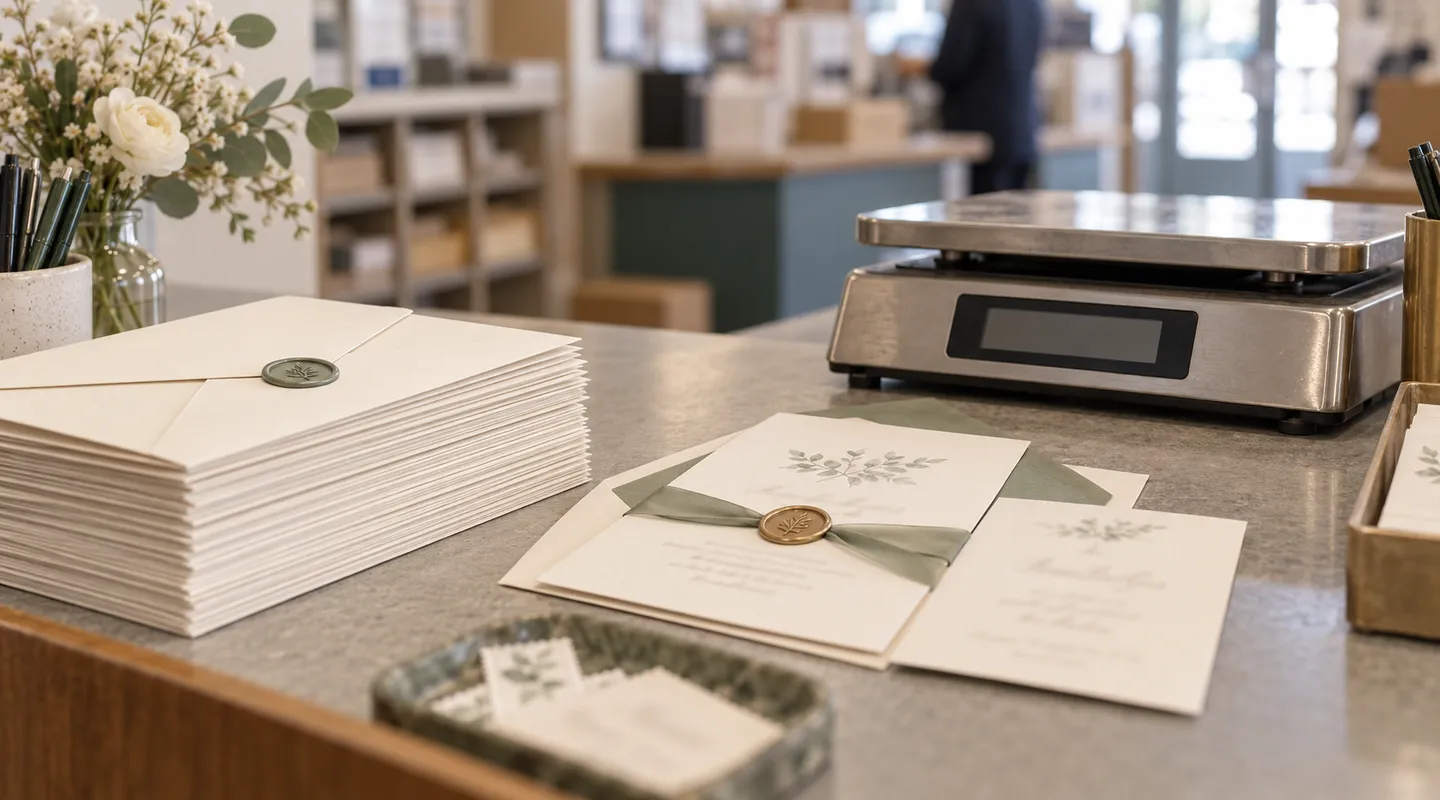
Assemble the exact combination that will go in the mail: main card, details card, response card, reply envelope, inner envelope if used, and any finishing pieces. Seal or close the sample as you plan to mail it.
Don't weigh only the main card. Emily Post's addressing and mailing guide recommends weighing an assembled invitation before buying stamps. It also says different versions with extra inserts may need separate checks.
If ten households receive a rehearsal dinner card, assemble that version too. The extra piece may affect the weight or thickness. Mark the household list if the heavier version needs different postage.
Use the details-card guide and rehearsal dinner insert guide to decide which pieces belong in each envelope before weighing.
Weigh one finished suite at the post office
Take the sample to a post office and ask for the correct postage and mailing category. USPS's letter guide explains how envelope size, weight, thickness and machinability affect mailing. Square, rigid or lumpy pieces may need different charges or handling.
Ask about any wax seal, ribbon or raised decoration on the outside. The complete mailing is what matters, not whether the card inside is a familiar size. A standard stamp is not a safe assumption for a multi-card suite.
Check the return response card too if guests will mail it back. A domestic reply envelope should carry its own correct postage. A postcard reply must meet USPS postcard rules, so ask about the chosen card stock and dimensions.
Check postage before you buy the whole batch. Keep the accepted sample and write down which combination it represents. That gives you a reference when you assemble the rest.
Ask about hand-canceling
Hand-canceling means applying a postmark by hand rather than relying on the usual cancellation machine at that step. Emily Post's mailing guide suggests asking whether the post office can hand-stamp the envelopes.
Ask your branch what it offers, when it can handle the batch and whether any charge applies. Don't promise yourself a service before the branch confirms it. Avoid assuming hand-canceling guarantees the envelope will never encounter equipment later in its route.
Keep the envelope address readable and the postage correctly placed. A decorative design should not interfere with postal details. Check the addressing guide before a calligrapher or printer finishes the envelopes.
If your mailpiece doesn't meet machinable letter requirements, follow the clerk's postage guidance. Hand-canceling is a handling request, not a way to avoid the correct mailing category.
A mailing-day checklist
Use one household list and mark each suite as you finish it. Keep invited people, address, insert version and send date in that list. A clear assembly process reduces the chance of putting a private event card in the wrong envelope.
- Check the household names and address against the current list.
- Match the inner envelope, if used, to the outer envelope.
- Add only the cards that household should receive.
- Check the reply card and return envelope.
- Apply the confirmed postage for that suite version.
- Seal after comparing the contents with the list.
- Deliver the batch using the post office's agreed process.
- Record the actual send date.
Keep spare invitations and envelopes for returned mail or corrections. Store them flat and dry. The card design guide covers paper and envelope choices before this final step.
Follow up after mailing
If a suite returns, check the address directly with the guest before sending again. Update the master list so the old address doesn't reappear. Give the guest the event details electronically if the reply deadline is close.
When someone says the invitation did not arrive, check the recorded send date and address. Share the website or reply route privately. A missing paper card should not prevent an invited guest from responding.
After the RSVP deadline, contact households without replies. The response-card guide helps you track attendance by person. Leave enough time to resolve incomplete names or meal choices before the vendor's final count.
Verdict on sending wedding invitations
When should you send wedding invitations comes down to the event and response schedule: 6–8 weeks for a standard wedding and about 3 months for destination plans. Choose the actual mailing date, check a complete suite at the post office and track each household. That turns the timing advice into a reliable send.
Questions people also ask
When do you send out wedding invitations?
Use six to eight weeks before a standard wedding and about three months for destination plans. Choose an actual mailing day that leaves room for replies and follow-up. Give travel notice earlier through save-the-dates and confirmed website details.
When should wedding invites go out if RSVPs are mailed?
Lean toward the earlier end of the standard six-to-eight-week window so replies have time to travel back. Set the reply deadline before the vendor's final count and leave time to contact missing households. Check the return postage as well.
When to mail wedding invitations for holiday weddings?
Lean toward the earlier end of the standard range, with more notice if the holiday and guest travel needs call for it. Share travel information early and check the actual vendor deadlines. Do not rely on a general date when a contract requires an earlier count.
Should we ask the post office to hand-cancel invitations?
Ask your branch what it can offer and whether a charge applies. Emily Post suggests asking about hand-stamping. Still use the correct postage for the complete mailpiece; a handling request does not replace USPS size, weight and machinability requirements.